

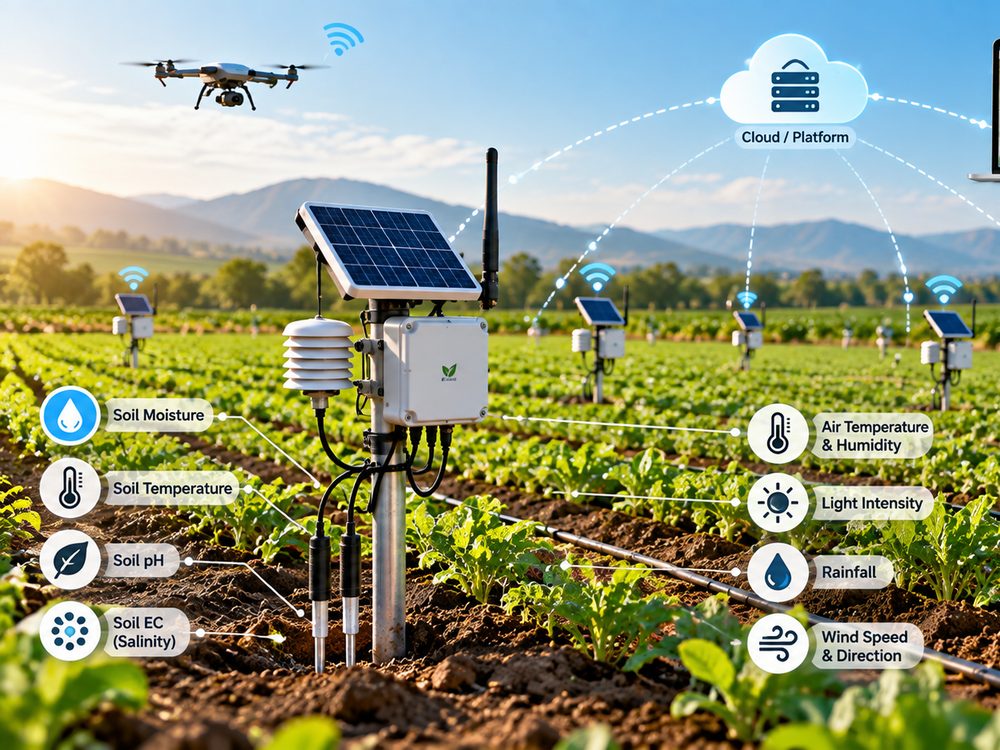
 Concept illustration
The IoT Sensor Node is designed to be the field's central sensing hub — one enclosure planned around an ESP32 microcontroller, with interchangeable, weatherproof probes plugged in below it. The soil probes are buried in the root zone, while the main enclosure, radio, and antenna sit above ground so the LoRa signal has a clear path to the gateway. It is designed to read soil moisture, soil EC, soil pH, air temperature and humidity (plus light and rain where fitted) every few minutes and radio the readings to the nearest gateway over LoRa, so the rest of the system can follow what's happening in that field.
Specifications| Microcontroller | To be confirmed |
|---|---|
| Communication | To be confirmed |
| Frequency | To be confirmed |
| Operating voltage | To be confirmed |
| Power source | Battery / Solar |
| Battery life | Design target, not yet field-verified; depends on configuration |
| Sensors supported | Planned: Soil moisture, soil temp., soil EC, soil pH, air temp., air humidity, light, rain |
| Enclosure | Weather-resistant design; rating to be confirmed |
| Operating temperature | To be confirmed |
Pairs with
Smart Valve Controller
Designed to act on what the Sensor Node reads — open the right irrigation valve automatically.
View spec sheet →Field Gateway
Designed to carry every Sensor Node's readings back to your dashboard.
View spec sheet →